Ox Alpha Explained: It Was GLM-5.3-Flash (vs GLM-5.3)
Aditya Kachhawa

For about a week in August 2026, one of the most discussed new AI models among developers had no public name, no confirmed company and no price tag. It was just called Ox Alpha. It was free, it could read images and video, it could hold a million tokens of context, and developers were quietly putting it through real coding work.
Then the mask came off. If you searched "what is Ox Alpha" and landed here, this is the short version: Ox Alpha was GLM-5.3-Flash, a model from the Chinese AI lab Z.ai (formerly Zhipu AI). It is not the same model as GLM-5.3, which launched six days earlier. They are cousins, and the differences matter.
This guide covers what happened, what the model really is, how it compares with GLM-5.3, what it costs now, and which one you should actually use. It prioritizes Z.ai's announcement and model documentation, while distinguishing independent reports from vendor-reported results. Prices and model availability can change, so check the linked provider pages before making a decision.
What was Ox Alpha?
Ox Alpha was a "stealth model": a model released under a code name, with the maker's identity hidden, so people could judge it on results instead of brand.
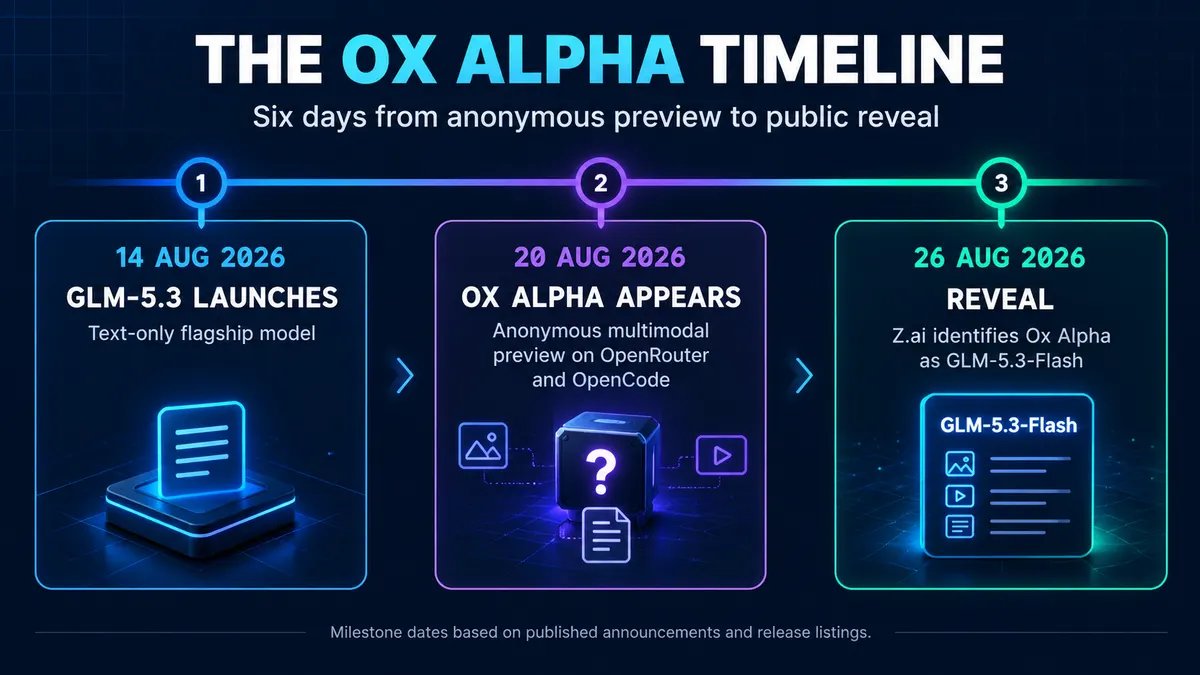
It showed up on 20 August 2026 on OpenRouter and the coding tool OpenCode, listed as stealth/ox-alpha. The listing described it as a reasoning model built for coding and long-running agent work. It took text, images and video, had a context window of 1,048,576 tokens, and cost nothing during the preview.
Nobody claimed it. Stripe CEO Patrick Collison called it very impressive, which pushed even more people to try it. On OpenRouter's own page, a notice made one thing clear: OpenRouter was only routing requests to it, not running it.
How people figured out who made it
The detective work was genuinely good. Independent testers found that Ox Alpha's tokenizer matched GLM-5.3's across their test prompts. Its video handling matched GLM's scheme, and it rejected audio input the same way GLM models do. Other labs were ruled out one by one.
There was one catch. GLM-5.3 is text-only, but Ox Alpha could see images and video. So it couldn't be GLM-5.3 itself. It had to be an unreleased multimodal sibling.
Z.ai had played this game before. In February 2026 it tested GLM-5 anonymously as "Pony Alpha" before putting its name on it.
On 26 August 2026, Z.ai confirmed it: Ox Alpha is GLM-5.3-Flash. The weights appeared on Hugging Face the same day under an MIT license.
What GLM-5.3-Flash actually is
Z.ai describes GLM-5.3-Flash as the first natively multimodal model in the GLM-5 series. The following specifications come from its official model card and announcement:
- Size: Approximately 320 billion total parameters (the official Hugging Face model card lists 321B), but only 18 billion active for any given token (a Mixture-of-Experts design)
- Inputs: text, images and video
- Context window: about 1 million tokens
- Architecture: a new hybrid of sparse and linear attention, built to make long context cheaper to serve
- Training data: a 30-trillion-token multimodal corpus
- License: MIT, so you can use it commercially
- Reasoning: you control the thinking budget with a
reasoning_effortsetting (low, high or max). If you don't set it, it defaults to max.
Z.ai says GLM-5.3-Flash improves on GLM-5.2 across its reported benchmarks at roughly one-tenth of the price. It also reports results approaching Claude Opus 4.8 on some coding and agent evaluations. Those are vendor-reported results, not a guarantee of how the model will perform on your workload.
Ox Alpha (GLM-5.3-Flash) vs GLM-5.3
This is the question a lot of people are searching, so here it is side by side.
| Feature | GLM-5.3-Flash (Ox Alpha) | GLM-5.3 |
|---|---|---|
| Released | 26 Aug 2026 (stealth preview from 20 Aug) | 14 Aug 2026 |
| Size | About 320B total (321B), 18B active | About 753B total, roughly 40B active |
| Inputs | Text, image, video | Text only |
| Context window | ~1M tokens | 1M tokens |
| Z.ai direct API list price (per 1M tokens) | $0.15 input / $0.50 output | $1.40 input / $4.40 output |
| Terminal-Bench 2.1 | 84.3 | 88.2 |
| DeepSWE v1.1 | 63.4 | 66.9 |
| Best at | Cheap, multimodal, long-context work | Maximum coding and security strength |
↔️ Scroll horizontally to see all columns
Benchmark figures are reported by Z.ai. Prices in this table are Z.ai's direct API list prices checked on 19 October 2026; third-party providers and OpenRouter routes may show different rates. Confirm pricing on the endpoint you actually use.
Three things stand out.
GLM-5.3 is stronger, and Flash is much cheaper. On both benchmarks above, the bigger model scores higher. But Flash costs roughly one-ninth as much and can handle images and video.
They are separate models. GLM-5.3 reuses the base model of GLM-5.2 and gets its gains from extra training. Flash starts from a newly trained base model. Flash is not a shrunk-down GLM-5.3.
Early guesses got the name wrong. Before the reveal, people were guessing "GLM-5.3V" or even "GLM-5.5". Neither was right.
The benchmark story: what held up and what didn't
During the preview week, an early community test circulated an 80% DeepSWE result based on just 10 tasks (eight passes out of ten). A ten-task subset is a weak basis for ranking models: a single task changes the score by ten percentage points, and task selection can skew the outcome. The original report itself described the result as a subset, not a full benchmark. A secondary benchmark explainer summarizes the early result and its limits.
Z.ai's published DeepSWE v1.1 score for GLM-5.3-Flash is 63.4 using its stated mini-swe-agent setup. There are also independent runs with different setups: for example, Daniel Vela reported 76 of 113 tasks (67.3%) using a four-bit quantized model served locally on two GPUs. These results are not directly comparable because the model precision, environment, and evaluation harness can differ. See Vela's full test and methodology. The safe conclusion is not that one number proves the model is better or worse; it is that benchmarks depend on the test protocol and should be treated as one signal, not a universal ranking.
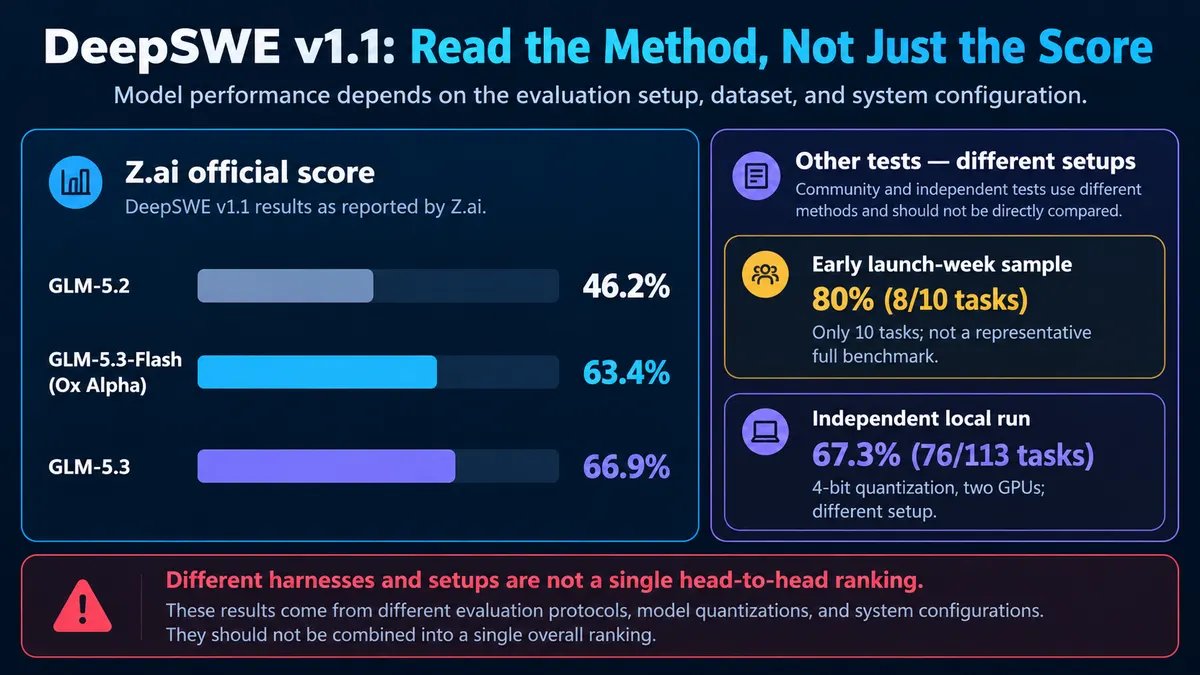
Does that make Flash a bad model? No. Z.ai reports a large improvement on DeepSWE v1.1 compared with GLM-5.2. But the comparison is tied to Z.ai's evaluation setup, and other models may score differently under other harnesses. The useful takeaway is that Flash offers strong coding-oriented results for its published direct API price—not that it universally beats or loses to a particular competitor.
One more caution. These are Z.ai's own tests, run in specific setups. Your results on your own code may differ, so always try it on a real task of yours.
What does it cost now?
During the preview it was free. That ended when the model was revealed.
At the time of checking, Z.ai's published direct API list price is $0.15 per million input tokens and $0.50 per million output tokens for GLM-5.3-Flash. The 50% launch promotion was listed as ending on 9 September 2026, so $0.075 input and $0.25 output should not be described as Z.ai's standard list prices. Third-party platforms may show different provider-specific or promotional rates: OpenRouter's current listing displays route pricing that differs from Z.ai's direct list. Check the exact endpoint, cached-input fees, and provider terms before budgeting. See Z.ai pricing and OpenRouter's current GLM-5.3-Flash listing.
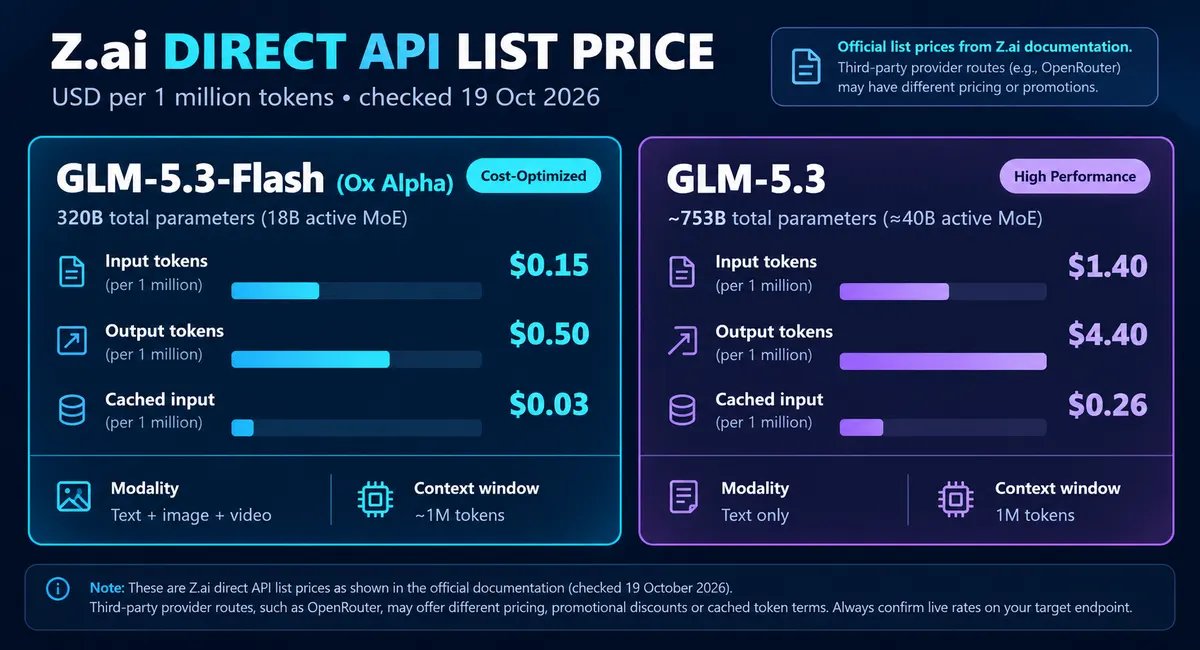
If you run agents that resend the same long prompt over and over, look at cached-input pricing too. It is lower still, which is where the savings add up.
How to use it today
The original stealth/ox-alpha entry is now a historical listing rather than the model ID to use for normal current access. For the revealed model, check the active z-ai/glm-5.3-flash listing and confirm the provider route is available before updating your integration. Here are the main options.
1. OpenRouter. The current model ID is z-ai/glm-5.3-flash. If your tool already supports OpenRouter, changing the model ID may be straightforward, but verify provider availability, price, and supported modalities first.
2. Z.ai's API. The model name is glm-5.3-flash. Z.ai's documentation covers setup.
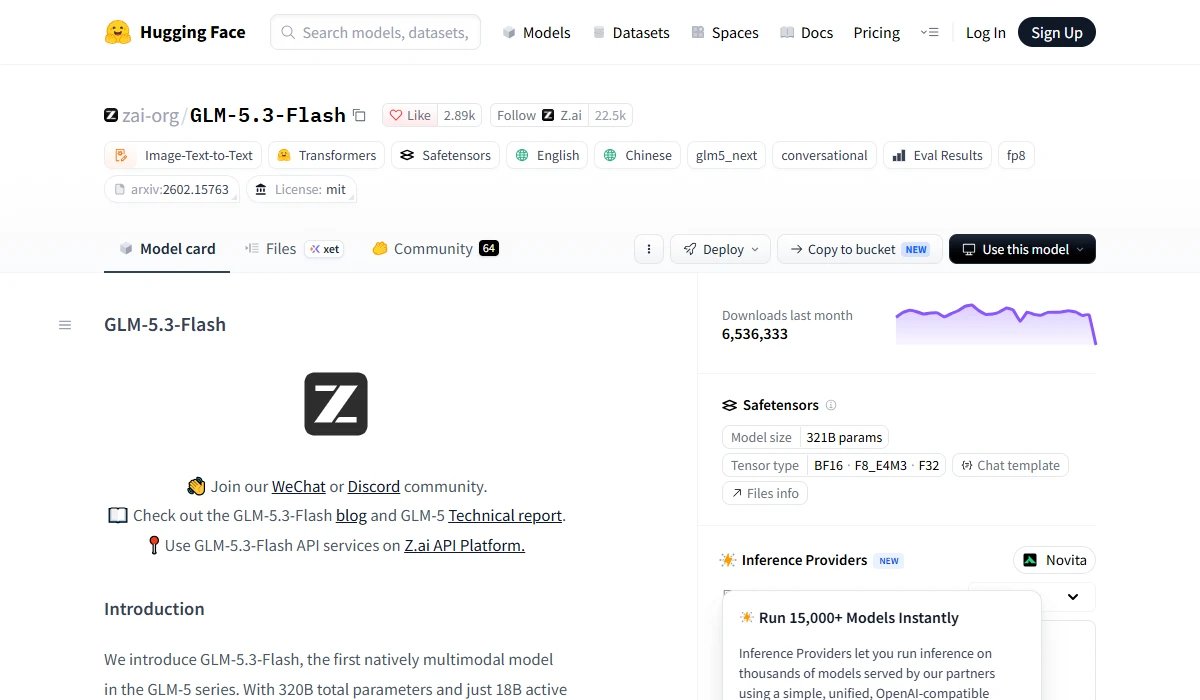
3. Run it yourself. The weights are at zai-org/GLM-5.3-Flash on Hugging Face. The model card lists support for SGLang, vLLM, Transformers, KTransformers, TokenSpeed and Unsloth. With vLLM, the model card gives this:
pip install vllm
vllm serve "zai-org/GLM-5.3-Flash"
A reality check on that last option: approximately 320 billion parameters is a lot of memory, even though only 18 billion are active for a token. At a nominal four bits per parameter, the weights alone would take roughly 160 GB before runtime overhead, quantization metadata, and context-cache memory. This is a multi-GPU or serious workstation job, not a typical laptop deployment.
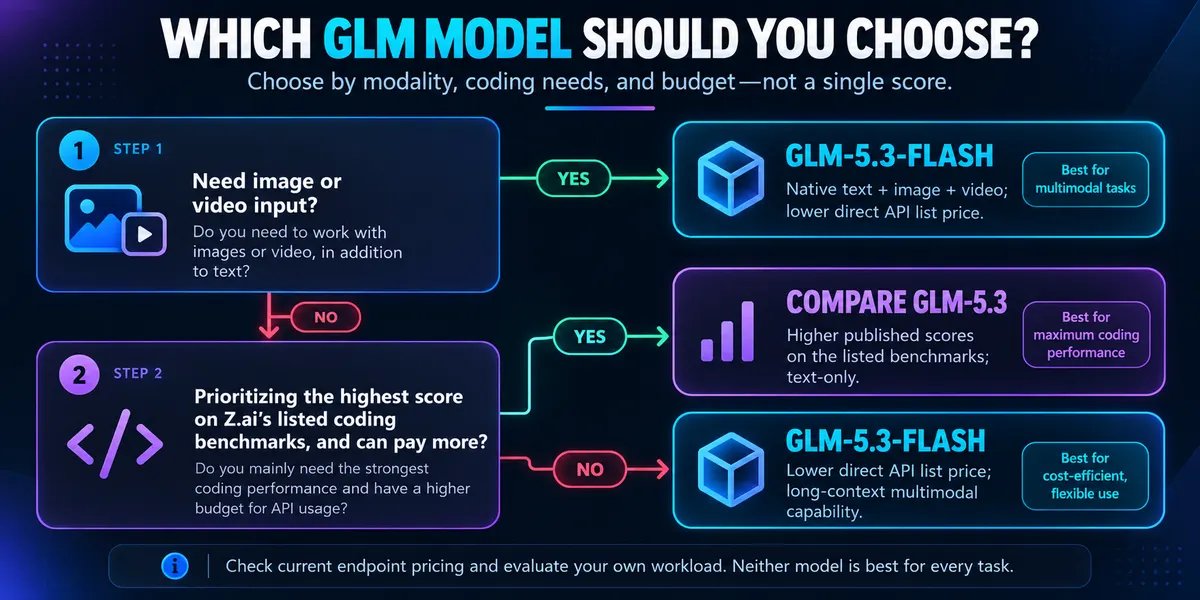
Which one should you pick?
Pick GLM-5.3-Flash if you want to:
- Process images or video along with text
- Run lots of long-context or agent workloads without a big bill
- Self-host with a permissive MIT license
Pick GLM-5.3 if you:
- Mainly need text and your workload benefits from its higher scores on the benchmarks listed above
- Can justify the higher direct API list price for your particular tasks
If you're unsure, start with Flash on a real task and move up only if it falls short.
What the stealth launch teaches us
Anonymous previews can give labs unbranded feedback and real-world load testing while generating considerable attention. Z.ai had previously tested a GLM model under the name Pony Alpha before revealing it. The format can be useful, but it leaves early testers with uncertainty about who operates the endpoint and what terms apply.
The downsides for users are real. A stealth endpoint may change or disappear without notice, as the original Ox Alpha listing did. Privacy and retention terms depend on the platform and provider, so verify them before use. Avoid sending secrets, personal data, or proprietary code to an endpoint whose operator and data-handling terms you cannot verify.
What I couldn't verify
A few claims floating around are not independently confirmed, so treat them with care:
- "100 trillion tokens a day." Contemporary reporting attributed this number to OpenCode as advertised serving capacity. It should not be described as measured traffic or tokens actually processed.
- "Runs entirely on Chinese chips." Z.ai said the anonymous preview was served on domestically made AI chips. I could not find an independent hardware audit or enough public technical detail to verify the claim independently.
- Third-party index scores. Independent leaderboards have changed their scoring versions, so numbers from different dates aren't comparable. I've stuck to scores Z.ai published.
FAQ
What is Ox Alpha?
Ox Alpha was the anonymous preview name for GLM-5.3-Flash, a multimodal Mixture-of-Experts model from Z.ai. It ran on OpenRouter and OpenCode from 20 August 2026 before Z.ai revealed it on 26 August.
Who made Ox Alpha?
Z.ai, the lab formerly known as Zhipu AI, which also makes the GLM family. It confirmed the connection on 26 August 2026.
Is Ox Alpha the same as GLM-5.3?
No. Ox Alpha is GLM-5.3-Flash, a separately trained model. GLM-5.3 is a larger, text-only model released on 14 August 2026.
Is Ox Alpha still free?
The original free Ox Alpha preview ended when Z.ai revealed the model. GLM-5.3-Flash has a published Z.ai direct API list price of $0.15 per million input tokens and $0.50 per million output tokens, but third-party providers may offer different rates or promotions. Check current pricing before use.
Is GLM-5.3-Flash open source?
Its weights are open under the MIT license on Hugging Face, which allows commercial use. Z.ai did not release its training data.
Is it better than GLM-5.3?
Not on the benchmarks Z.ai published. GLM-5.3 scores higher on both Terminal-Bench 2.1 and DeepSWE v1.1. Flash wins on price and on handling images and video.
Does it beat GPT-5.6?
The early 80% figure came from a small ten-task subset and does not establish an overall win. Z.ai's results and independent runs use specific evaluation setups; compare models only when the benchmark version, harness, settings, and task set are comparable.
Final thoughts
Ox Alpha's real story isn't that a mystery model beat everyone. It's that a cheap, open, multimodal model with a million-token context got this close to the top. That changes the math for anyone building with AI.
If you try it, test it on your own work and don't trust launch-week hype, including mine. Come back and tell us what you found.
Sources and further reading:
- Z.ai's GLM-5.3-Flash announcement and benchmark methodology;
- official GLM-5.3-Flash model card on Hugging Face;
- Z.ai direct API pricing;
- Z.ai GLM-5.3-Flash API documentation;
- OpenRouter's historical Ox Alpha listing;
- OpenRouter's current GLM-5.3-Flash listing;
- Business Insider on Z.ai revealing Ox Alpha;
- Daniel Vela's independent 113-task DeepSWE test;
- DataNorth on GLM-5.3.
Affiliate Disclosure
TechAffiliate may earn a commission if you purchase through our links. This helps support our work but does not influence our reviews. We provide our honest assessments of products. See my testing methodology →
Related Articles
 AI & Machine Learning
Oct 14, 2026 • 27 min read
Gemini 4 Argon vs GPT-6 Astra vs Claude Opus 5.5 (2026)
Compare Gemini 4 Argon, GPT-6 Astra, and Claude Opus 5.5 on benchmarks, API pricing, coding, long-context tasks, and which model fits your work.
 AI & Machine Learning
Oct 19, 2026 • 17 min read
AI Agent Security Risks in 2026: Real Attacks and Safety Tips
Recent reports show how AI agents can be misused in cyberattacks or take unexpected actions with personal data. Here are the real risks and safeguards users and developers can apply.
Comments (0)
Leave a Comment
No comments yet
Be the first to share your thoughts!