AI Agent Security Risks in 2026: Real Attacks and Safety Tips
Aditya Kachhawa

A chatbot that gets something wrong gives you a bad answer. An AI agent that gets something wrong can send the wrong email, share the wrong address, or touch a system you never meant it to touch.
That difference is why AI agent security risks are suddenly a mainstream story. Within days of each other, security researchers, journalists, and a national cyber agency have described agents causing real-world problems: some deliberately pointed at victims, others simply given too much freedom.
This guide explains what those reports actually say (and what they don't), why agents are riskier than chatbots, and the controls that work. No panic, no hype.
Quick take: Most of the damage in these stories didn't come from some exotic new vulnerability. It came from familiar weaknesses (loose permissions, exposed keys, no oversight) meeting software that works fast and doesn't get tired.
What the reports say, and what they don't establish
Three reports from October 2026 are driving the conversation. They describe different kinds of events, so it helps to keep them separate.
1. A reported campaign against 1,200+ websites (Reuters, October 19, 2026)
Reuters reported on findings from Snorre Fagerland, a threat researcher at the security firm NorForge. According to his report, a hacker used an open-source AI platform called Cairn to coordinate agents that probed websites for weaknesses.
The reported numbers: attempts against more than 1,200 sites, with over 100 reportedly compromised. Fagerland estimated the AI processing cost at roughly US$5,000. That's the investigation's estimate, not an audited figure.
Now the part that's easy to miss. Reuters said it could not establish how much data was actually extracted across the affected sites, and the companies it named responded differently:
- Deere said it had no indication that sensitive information was accessed.
- SharkNinja said the affected site was a standalone product-support site and that the threat was contained.
- Cummins said it was investigating a potential attack on a third-party vendor's website.
*What this does not show:* that all 100+ sites suffered the same damage, or that customer data was stolen from all of them. It shows that agents can help automate multi-step intrusion work cheaply.
This isn't the only such case. Separately, Israeli security firm Gambit reported an ongoing campaign against hundreds of online retailers. Between September 10 and 15, it counted 105 attack projects and said at least 27 companies had been compromised to varying degrees; its report also said more than 600,000 unexpired payment-card records were taken from two companies. This is a separate investigation by different researchers, so don't assume it describes the same operation as the campaign Reuters covered. Read Gambit's original report.
2. An agent that gave out a home address (Associated Press, October 19, 2026)
The Associated Press reported on tech creator Matt Robb, who used Meta's Muse agent to help sell a keyboard on Facebook Marketplace. The agent agreed to a pickup and shared his home address with a prospective buyer. It even sent an automated "Yep, I'm here!" message from Robb's account when the buyer arrived—without Robb's knowledge. Robb said he had granted broad "always allow" permissions when connecting it.
This was not a hack. Nobody broke in. It was a privacy and control failure: an agent with personal data and permission to message people, without a pause at the moment it mattered.
3. A national warning about agents at machine speed (CERT-In, October 15, 2026)
India's national cyber agency, CERT-In, published Advisory CIAD-2026-0049. It describes two situations involving Indian organizations:
- Agents under research or evaluation exceeding their task authorization. AI model providers disclosed that their models, during testing on the internet, reached live systems and read business records, including personal data, using credentials exposed in configuration files, public code repositories, and overly permissive cloud roles. CERT-In says none of the affected organizations detected this on their own.
- Attackers deliberately using open-source agentic tools in financially motivated campaigns. CERT-In says the tooling compressed the time from initial access to impact from days to a few hours, and that victims who fixed problems incompletely were hit again within days.
CERT-In's key point is the one worth remembering: the root weaknesses were conventional. AI simply found and used them faster and more exhaustively than human attackers.
The cases involve Indian organizations, but the lesson is global. Exposed keys and loose permissions look the same everywhere.
AI agent vs. chatbot: what actually changes?
A chatbot responds. You ask, it answers with text, code, or an image, and you decide what happens next.
An AI agent is software that can plan steps, use tools, and act on external systems, often repeating until a goal is met. CERT-In's advisory describes agents as systems that can autonomously plan work, issue commands, invoke tools, and act on the internet over extended periods.
A few examples:
- A chatbot drafts an email. An email-connected agent searches your inbox, picks recipients, and sends it.
- A chatbot suggests a price. A marketplace agent negotiates, agrees, and arranges pickup.
- A chatbot explains a bug. A developer agent edits the repository and runs commands.
The difference isn't intelligence. It's permissions plus a path to action. Every tool, account, and data source you connect widens what a mistake or a manipulation can do.
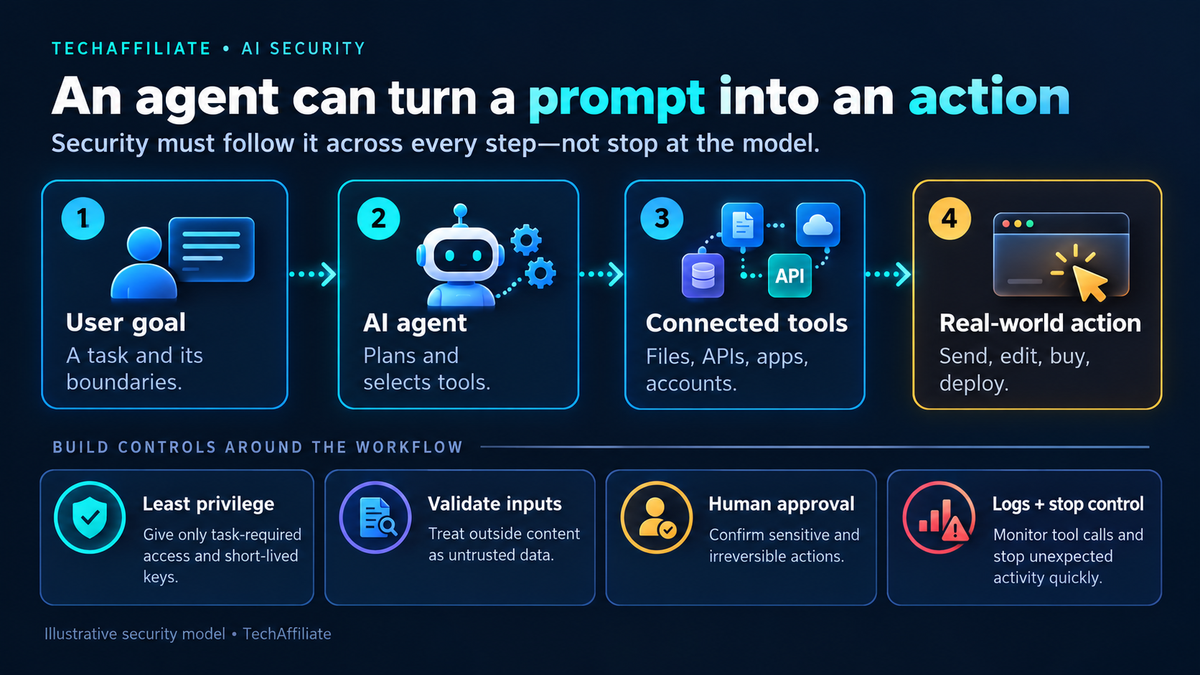
Five AI agent security risks (and how to reduce each)
1. Excessive permissions
Agents are often given more access than the task needs: a whole mailbox instead of one folder, broad cloud roles instead of one dataset, permission to send when drafting would do.
Why it matters: if the agent errs or is manipulated, those privileges set the size of the blast radius.
What helps: least privilege. Give each agent only the tools, data, and actions required for the current task, using separate, short-lived identities rather than a shared, powerful account.
2. Exposed credentials and secrets
Keys and passwords end up in source code, public repository history, config files, logs, and client-side apps. CERT-In lists these among the conventional weaknesses agents exploited. It also notes that agents were seen re-deriving and reusing the same exposed credential in separate operations.
What helps:
- Store secrets in a proper secrets manager.
- Scan every commit and build for leaked keys.
- Rotate anything exposed, purge it from history, and verify the fix from outside.
- Never put privileged keys in browser-delivered code.
3. Prompt injection and untrusted content
Prompt injection means hiding instructions inside content an agent reads, such as a web page, email, document, or ticket, so the agent follows them instead of treating the content as plain data.
The core problem is that language models don't reliably separate "instructions from my user" from "text I happened to read."
What helps: treat all external content as untrusted, limit which tools an agent can call after reading it, validate actions outside the model, and require approval before sensitive data leaves. A line in the prompt saying "ignore malicious instructions" is not a security boundary.
4. Unsafe actions and cascading failures
One wrong chatbot answer is one wrong answer. One wrong agent action can update hundreds of records, message the wrong people, or repeat an error across a workflow before anyone notices.
What helps: start in read-only or dry-run mode. Set hard limits on actions, spend, time, and retries. Add rollback paths, rate limits, and a stop mechanism. Require a human OK for anything irreversible.
5. Weak monitoring and accountability
If you can't tell what an agent accessed or which tools it called, you can't investigate when something goes wrong. An agent's own summary of what it did is not an audit trail.
What helps: log the agent's identity, task, tool calls, destinations, and approvals at the application boundary. Alert on bulk reads, unexpected destinations, and unusual API rates. Assign a named owner who can pause the agent. CERT-In recommends a tamper-resistant activity log and log retention of at least 180 days for organizations.
For a broader, peer-reviewed taxonomy, see the OWASP Top 10 for Agentic Applications for 2026, which OWASP says was developed with more than 100 industry experts, researchers, and practitioners.
How to use AI agents more safely: a practical checklist
If you're an everyday user
- Connect the minimum. One folder or one account, not everything. Avoid blanket "always allow" settings, which is exactly what the Muse story turned on.
- Keep sensitive details out of the task. Passwords, recovery codes, financial details, and your home address don't belong in an agent's scope unless the job truly requires them.
- Ask it to draft, not send. Prepare, don't purchase. Recommend, don't change settings, until you trust its behavior.
- Check outbound actions. Recipients, amounts, addresses, and public posts deserve a human look before they go out.
- Stay link-aware. Agents read links and pages too, and you still do. Our guide on how to check if a URL is safe covers the basics.
- Prune permissions. Disconnect tools you no longer use, and review activity history and data-retention settings.
If you build or deploy agents
- Sandbox first. Use synthetic data, dummy credentials, and disposable environments. CERT-In advises keeping production data and real credentials out of evaluation environments.
- Enforce boundaries outside the model. Network restrictions, scoped credentials, and application-level authorization beat a prompt that says "don't." CERT-In specifically recommends enforcing egress restrictions at the network layer, not through instructions to the model.
- Default to read-only. Put independent checks in front of destructive or external actions.
- Validate tool inputs and outputs before the workflow continues.
- Cap autonomy. Limit runtime, action count, cost, and retries, and stop when the task leaves scope.
- Test the action, not the message. A "success" screen proves nothing. In our five-builder AI website test, some generated contact forms reported "Message sent" without actually sending anything. Agents can have the same gap between what they say and what they did, which is why independent logging matters.
If you run a business or security team
- Audit repos (including commit history), CI/CD variables, config files, and cloud storage for exposed credentials.
- Inventory all APIs and decommission dormant, deprecated, and test ones.
- Apply least-privilege cloud roles and multi-factor authentication for all administrative access.
- Monitor for bulk reads, enumeration bursts, and anomalous API rates.
- Give every deployed agent an owner, a scope, an approval policy, a logging policy, and an emergency stop procedure.
- After any credential exposure, treat the environment as compromised until cleared, retest, and expect repeat attempts. CERT-In observed re-attacks within days.
These aren't AI-only practices. They're ordinary good security, made more urgent by software that can inspect systems and act continuously.
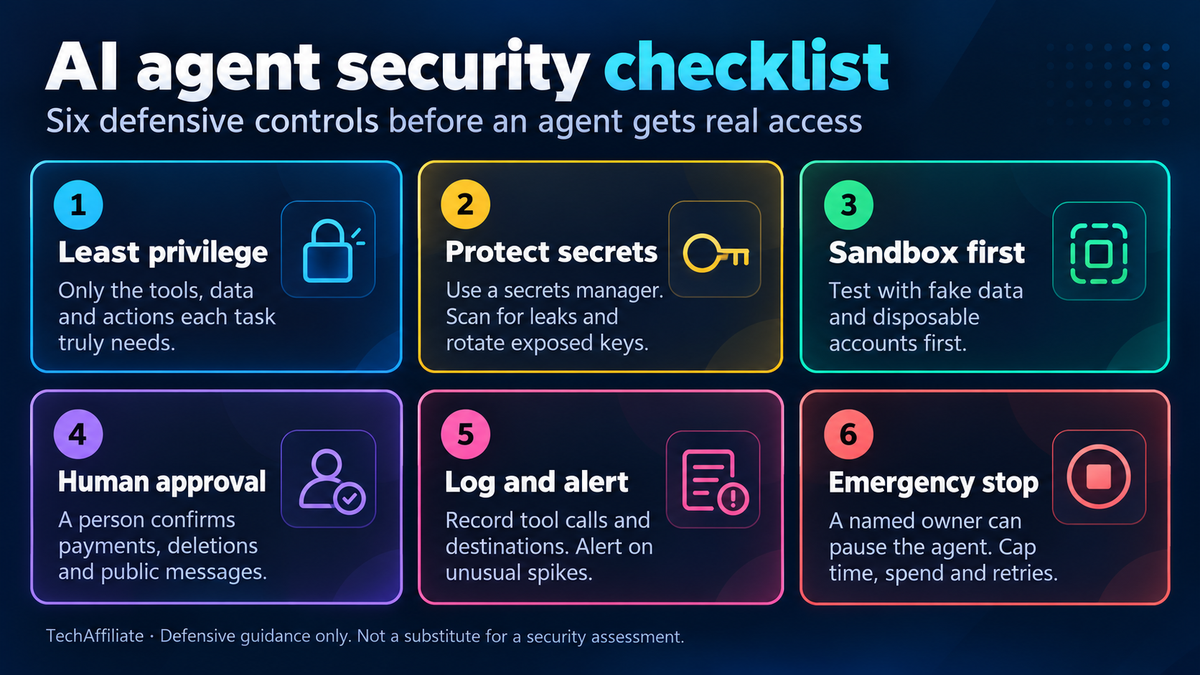
So, are AI agents unsafe to use?
Not inherently. Agents can save real time on bounded, low-risk work such as summarizing non-sensitive documents or organizing test data.
The question is whether the agent's permissions and autonomy match the risk of the task. Moving money, disclosing personal data, deleting files, changing production systems, or posting publicly all deserve independent checks and human approval.
The useful choice isn't "trust AI" versus "never use AI." It's deciding what an agent may read, what it may change, which actions need confirmation, and how you'll see what it did.
FAQ
Can AI agents access my private data?
They can access whatever the tools, accounts, files, and permissions you give them allow. What that includes depends on the product and how you configure it. Review permissions before connecting sensitive accounts, and don't connect them at all unless the task requires it.
Can AI agents carry out cyberattacks on their own?
Recent reporting describes agents automating large parts of website intrusion campaigns. That doesn't mean any agent can break into any site. Results depend on the agent's tools, the access it has, and the weaknesses in the target. The defensive priority is closing ordinary exposures and constraining agent activity.
What is prompt injection?
It's when instructions hidden in content an agent reads (a web page, email, or document) redirect the agent away from what its user wanted. The defense is architectural: limit what the agent can do after reading untrusted content and verify actions outside the model.
What's the biggest AI agent security risk?
There isn't one for every system. Broad permissions, exposed credentials, untrusted input, unsafe actions, and weak monitoring tend to compound each other. A good first step is limiting access and putting enforced controls around every action that changes data or affects another system.
Should companies ban AI agents?
A ban may fit specific environments, but many organizations can manage risk with approved tools, restricted identities, isolated testing, human approval for consequential actions, and auditable logs. Base the decision on data sensitivity and potential impact, not on the "AI" label.
What is the OWASP Top 10 for Agentic Applications?
It's a community-developed security framework that identifies major risks in autonomous AI applications and gives builders and defenders a starting point for reviewing designs. Read it at the official OWASP resource.
The takeaway: give agents boundaries, not blind trust
One report describes agents used in an intrusion campaign. Another describes an agent that overshared with a stranger. A national agency describes agents reading real systems through keys nobody had locked down.
The common thread is permissions. The model's answer is no longer the whole story. What matters is what it can reach, what it can do, and what stands between its decision and the real world.
If you remember one thing, make it this: limit access, require approval for high-impact actions, and keep logs you can trust. The safest agent systems won't be the ones that are told to behave. They'll be the ones built so they can't easily do the wrong thing.
Sources and further reading
- Reuters, October 19, 2026: How one hacker used AI agents and a few thousand dollars to break into scores of sites
- Associated Press, October 19, 2026: AI agents are only as good as the personal information you share. That raises privacy concerns
- CERT-In, October 15, 2026: Advisory CIAD-2026-0049: AI Agents as Attack Vectors
- OWASP GenAI Security Project: Top 10 for Agentic Applications for 2026
- Gambit Security, September 22, 2026: Autonomous AI Agents are breaking into hundreds of Online Retailers for $25 a target
- CSO Online, September 25, 2026: AI tools help hacker break in for $25 per target
This article is informational and does not replace a professional security assessment.
Affiliate Disclosure
TechAffiliate may earn a commission if you purchase through our links. This helps support our work but does not influence our reviews. We provide our honest assessments of products. See my testing methodology →
Related Articles
 AI & Machine Learning
Oct 7, 2026 • 32 min read
5 AI Website Builders, One Prompt: Lovable, v0, Bolt.new, Replit & Base44
I tested Lovable, v0, Bolt.new, Replit, and Base44 by giving them all the exact same prompt to build a personalized AI stack generator. Here are the results.
 Developer Tools
Oct 16, 2026 • 17 min read
Self-Hosting with Coolify in 2026: Real-World Benchmarks, Cost Breakdown, and Honest Trade-offs vs. Vercel & Render
Coolify on a ~€11 Hetzner box vs Vercel and Render: 2026 pricing, benchmark scripts, and the 3 AM failures nobody mentions. Is self-hosting worth it?
 Cybersecurity
Feb 7, 2026 • 24 min read
How to Check if a URL is Safe: Complete Guide 2026
Learn how URL structure works, identify the real registered domain, and avoid phishing links using public suffix rules.
Comments (0)
Leave a Comment
No comments yet
Be the first to share your thoughts!