Claude Opus 5 Review: Is It Better Than GPT-5.6 for Coding, Research and AI Agents?
Aditya Kachhawa

Pros
Cons
Claude Opus 5 arrived on July 24, 2026 only weeks after OpenAI released the GPT-5.6 family. Both companies are pitching their latest models at the same demanding users: developers handling large codebases, researchers working across many sources, and teams building AI agents that must keep working after the first tool call.
That creates an obvious question: is Claude Opus 5 actually better than GPT-5.6 Sol?
The honest answer is more useful than a simple winner. Claude Opus 5 currently has some of the strongest evidence for agentic knowledge work and difficult software-engineering tasks. GPT-5.6 Sol remains exceptionally competitive, has a slightly larger context window, offers a broader OpenAI tool ecosystem, and can power multi-agent workflows. The better choice depends on what you need the model to finish not which launch chart looks more impressive.
Testing disclosure: This is a research-led review based on official documentation, published evaluations, pricing data and independently checkable sources. TechAffiliate did not run a controlled hands-on comparison of both models for this version of the article. Company-reported benchmark results are identified as such.
Quick verdict: Claude Opus 5 is not universally better than GPT-5.6 Sol, but it is a compelling choice for long-running coding, document-heavy professional work and agents that need to verify and revise their own output. Third-party evaluator Artificial Analysis places Opus 5 slightly ahead on its overall Intelligence Index and clearly ahead on its GDPval-AA v2 knowledge-work benchmark. GPT-5.6 Sol remains extremely strong for terminal coding, web research, computer use and workflows built around ChatGPT, Codex, the Responses API or OpenAI's multi-agent beta. Claude is also slightly cheaper on output tokens: $25 per million versus $30 for Sol. For high-volume applications, however, GPT-5.6 Terra or Luna may be more economical than either flagship model. Readers should wait for more controlled real-world tests before treating any benchmark lead as a universal verdict.
Key takeaways
- Claude Opus 5 has the stronger recent evidence for agentic knowledge work, including the highest reported GDPval-AA v2 and AA-Briefcase scores from Artificial Analysis.
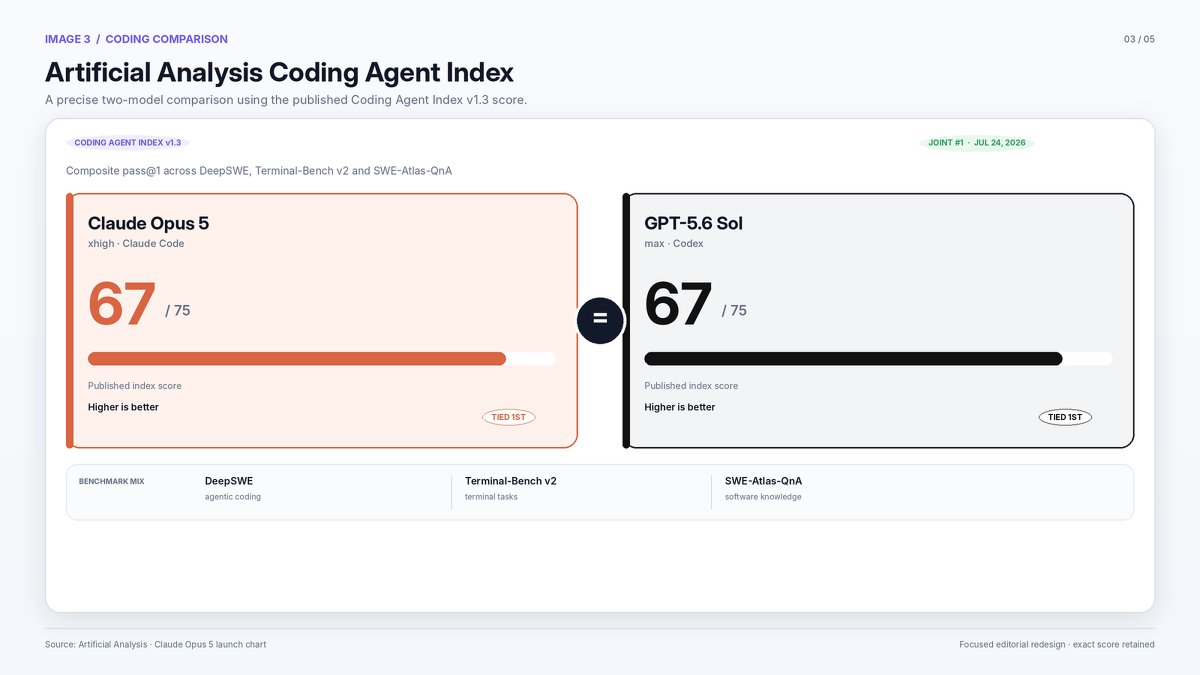
- Coding is close rather than settled. Opus 5 is joint first on Artificial Analysis's Coding Agent Index, while GPT-5.6 Sol remains a leader on terminal-based coding.
- Claude is cheaper for generated output, although both flagships charge $5 per million input tokens.
- GPT-5.6 has the broader price ladder. Terra and Luna give developers lower-cost options without leaving the GPT-5.6 family.
- Neither model should operate without oversight when it can edit files, execute commands, send messages or access sensitive data.
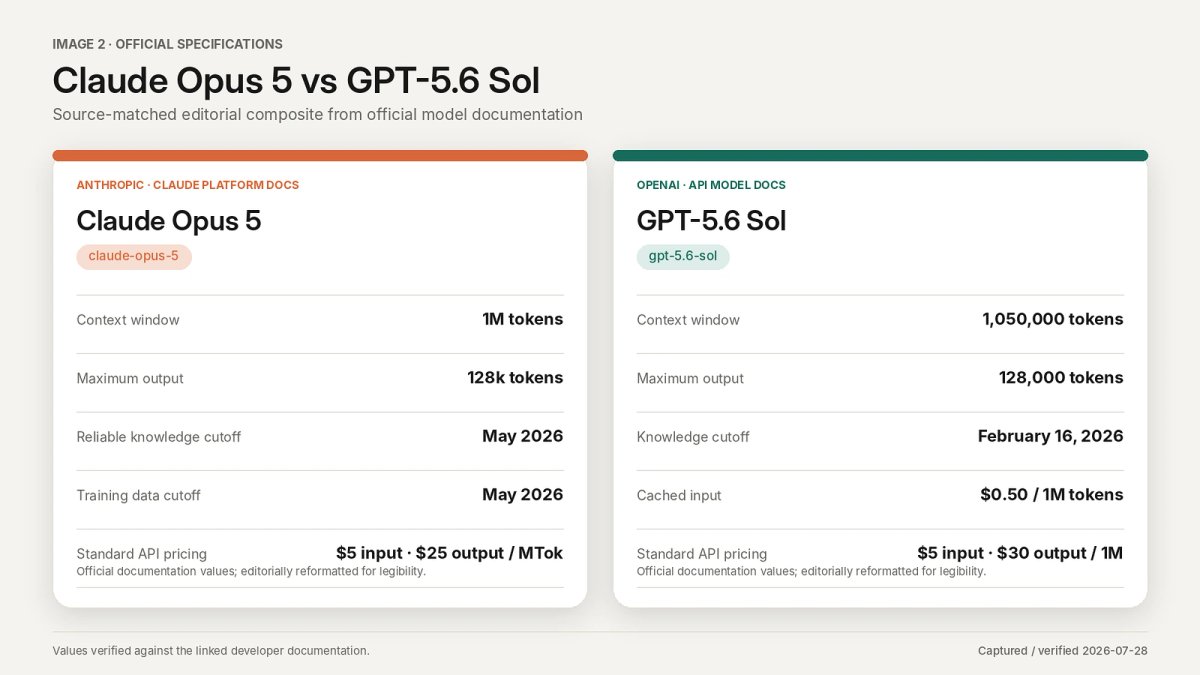
Claude Opus 5 vs GPT-5.6 Sol: specifications
| Feature | Claude Opus 5 | GPT-5.6 Sol |
|---|---|---|
| Announced | July 24, 2026 | July 9, 2026 |
| Position | Opus model for complex agentic coding and enterprise work | GPT-5.6 flagship for complex professional work |
| API model | `claude-opus-5` | `gpt-5.6-sol`; `gpt-5.6` routes to Sol |
| Context window | 1,000,000 tokens | 1,050,000 tokens |
| Maximum synchronous output | 128,000 tokens | 128,000 tokens |
| Knowledge cutoff | May 2026 | February 16, 2026 |
| Standard input price | $5 per 1M tokens | $5 per 1M tokens |
| Standard output price | $25 per 1M tokens | $30 per 1M tokens |
| Cached-input price | $0.50 per 1M tokens | $0.50 per 1M tokens |
| Reasoning controls | Adaptive thinking; low, medium, high, xhigh and max effort | Multiple reasoning levels; Sol supports higher-effort reasoning |
| Main agent advantage | Long-horizon work, self-checking, Claude Code and flexible tool workflows | Codex, Responses API, ChatGPT Work and multi-agent beta |
| Main limitation | Premium model; factual confidence still requires checking | Output is costlier; availability varies by product and plan |
↔️ Scroll horizontally to see all columns
What are Claude Opus 5 and GPT-5.6 Sol?
Claude Opus 5 is Anthropic's newest Opus-tier model. Anthropic recommends it for complex agentic coding and enterprise work, while its more expensive Fable 5 model remains the company's highest widely available capability tier. Opus 5 uses adaptive thinking, meaning it can vary how much internal reasoning effort it applies based on the task and the selected effort setting.
GPT-5.6 is a family rather than one model. Sol is the flagship, Terra balances intelligence and cost, and Luna targets fast, high-volume workloads. This review compares Claude Opus 5 with GPT-5.6 Sol because those are the closest premium options.
A token is a small unit of text processed by a model. A context window is the total amount of information the model can consider in a request or ongoing session. An AI agent is a model connected to tools, such as a terminal, browser, file system or business application so it can take multiple actions instead of only producing a reply.
How we evaluated the models
This comparison uses three kinds of evidence:
- Official specifications and pricing from Anthropic and OpenAI.
- Company-published benchmark results, treated as vendor claims.
- Results from Artificial Analysis, which says it supported both companies with pre-release evaluations.
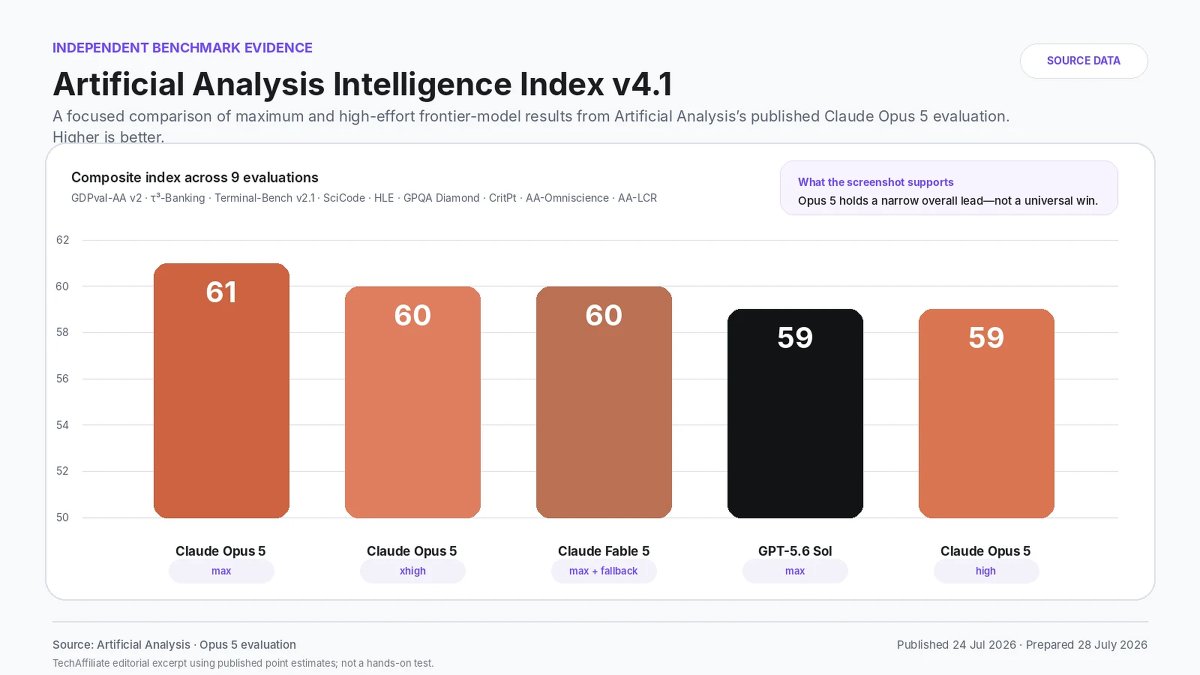
That last point matters. Artificial Analysis provides useful standardized comparisons, but no benchmark recreates every real codebase, research task or production agent. Scores can also change with the model's reasoning level, agent harness, tools, time limit and token budget.
The conclusions below therefore describe where the available evidence points, not a permanent ranking.
Claude Opus 5 vs GPT-5.6 for coding
Claude Opus 5 is built for work that lasts longer than a single code suggestion. Anthropic says the model improved substantially on difficult debugging, code review, repository-wide changes and tasks where the model must inspect its own result before finishing. Its launch materials report a lead on Frontier-Bench v0.1 and strong performance on CursorBench at higher effort settings.
The stronger cross-company evidence comes from Artificial Analysis's Opus 5 evaluation. It reports that Claude Code with Opus 5 at xhigh effort is joint first on its Coding Agent Index and that Opus 5 reaches about 89% on Terminal-Bench v2.1, roughly in line with the leading GPT-5.6 Sol configuration.
GPT-5.6 Sol is still a formidable coding model. OpenAI reported an 88.8% Terminal-Bench 2.1 score for Sol and 91.9% for its multi-agent configuration at launch. The model also benefits from Codex, hosted shell tools, apply-patch support, computer use and OpenAI's Responses API. Those surrounding tools can matter as much as the underlying model.
For a small function or quick bug fix, either model may be excessive. The real distinction appears on larger jobs:
- Choose Claude Opus 5 when the task requires careful architectural judgment, restrained code changes, code review or sustained work across a large repository.
- Choose GPT-5.6 Sol when your workflow already lives in Codex or depends heavily on OpenAI's terminal, computer-use and multi-agent tooling.
- Consider GPT-5.6 Terra or Claude Sonnet 5 for routine coding where price and speed matter more than squeezing out the best result.
Coding verdict: Claude Opus 5 has a slight evidence-based edge for careful, long-horizon software engineering, but GPT-5.6 Sol remains close enough that the agent environment and task type may decide the winner.
Claude Opus 5 vs GPT-5.6 for research
“Research” can mean two different things. One task involves reasoning through documents already provided. The other involves finding current information on the web, judging sources and producing traceable citations.
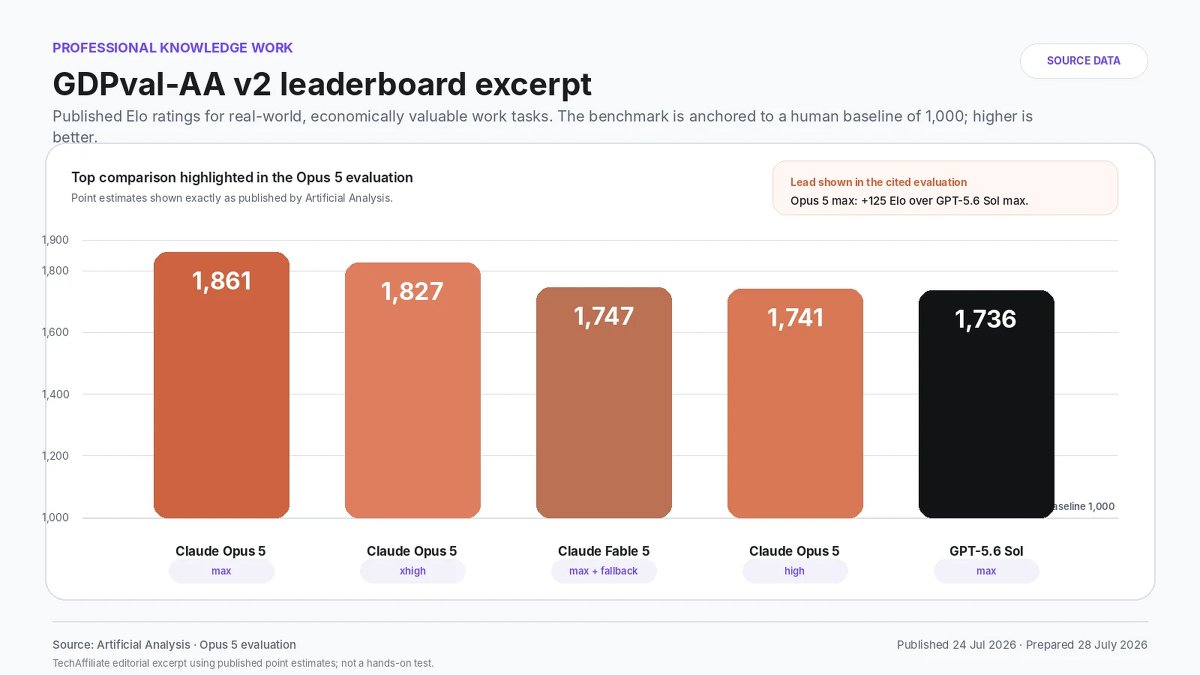
Claude Opus 5 currently looks especially strong for the first category. Artificial Analysis reports that Opus 5 at max effort scored 1,861 Elo on GDPval-AA v2, more than 100 points ahead of Fable 5 and GPT-5.6 Sol. It also led AA-Briefcase, a benchmark involving long-horizon professional deliverables such as presentations, spreadsheets and memos.
OpenAI's strongest case is browsing and tool-connected knowledge work. OpenAI reports that GPT-5.6 Sol reached 90.4% on BrowseComp, while a multi-agent configuration reached 92.2%. The launch also emphasizes improved work with documents, spreadsheets, presentations, Slack, Notion, Microsoft 365 and Google Drive.
There is an important warning on both sides: a model can produce an excellent-looking report and still misread a source or invent a detail. Artificial Analysis found that Opus 5 improved factual knowledge over Opus 4.8 but also answered more often when uncertain, resulting in a higher measured hallucination rate on its AA-Omniscience evaluation. That is a strong reason to verify every important claim, quotation and citation.
Research verdict: Claude Opus 5 appears stronger for deep analysis and polished professional deliverables; GPT-5.6 Sol may be the better fit for browsing-heavy research inside OpenAI's tool ecosystem. Neither should be trusted without source checking.
Claude Opus 5 vs GPT-5.6 for AI agents
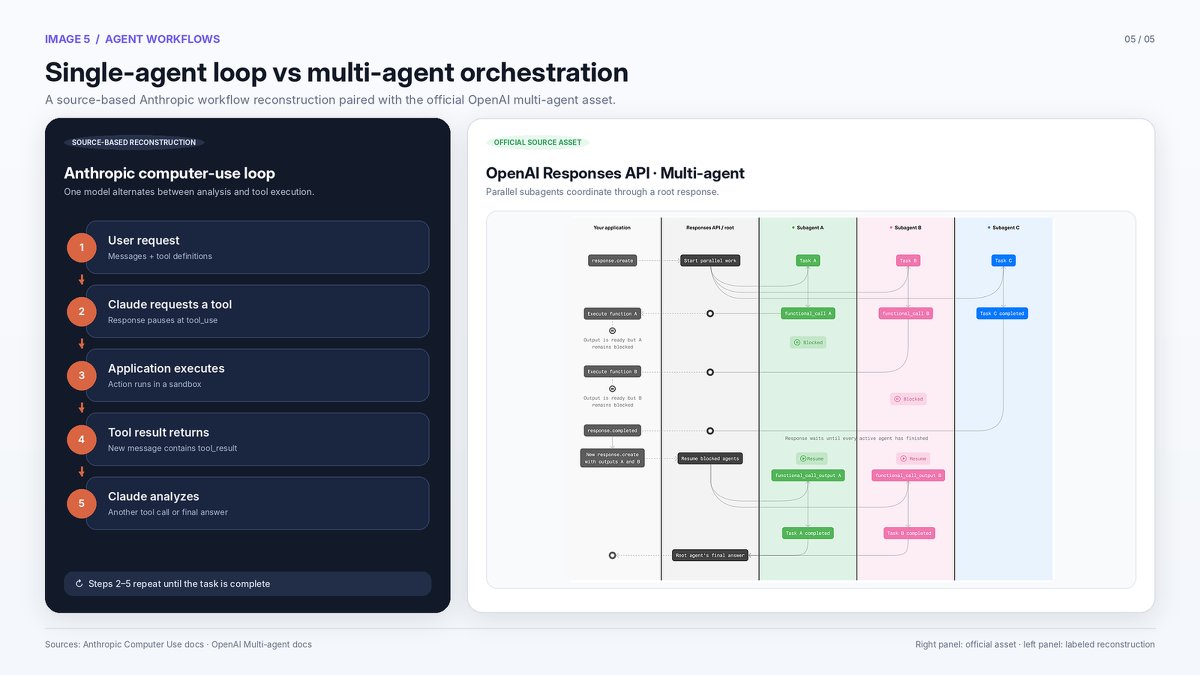
An agent must do more than “think.” It must choose tools, recover from errors, preserve context and know when to stop or ask for approval.
Claude Opus 5 is designed around this kind of persistent work. Anthropic says it is more proactive about checking its own results and can maintain the thread across long, multi-stage tasks. The Claude platform also introduced beta support for changing available tools during a conversation without breaking the prompt cache, plus optional fallbacks when a request triggers a safety classifier.
GPT-5.6 Sol has a different strength: orchestration. OpenAI introduced a multi-agent beta in the Responses API, allowing developers to create workflows in which specialized subagents work on parts of a larger task. GPT-5.6 also connects naturally with ChatGPT Work, Codex, web search, file search, hosted shell, computer use, Model Context Protocol tools and business connectors.
The model alone does not determine whether an agent is reliable. A production system also needs:
- Permission boundaries and approval steps
- Logs and recoverable checkpoints
- Spending and tool-call limits
- Tests before code is merged
- Human review before external messages are sent
- Protection against prompt injection and untrusted files
Agent verdict: Claude Opus 5 is the more convincing single-agent choice for careful, sustained execution. GPT-5.6 Sol is especially attractive when you need a wider OpenAI tool stack or explicit multi-agent orchestration.
Long context: bigger is not the same as perfect
Claude Opus 5 supports one million tokens; GPT-5.6 Sol supports 1.05 million. Both can theoretically accept enormous codebases, document collections or project histories.
The 50,000-token difference is unlikely to matter for most readers. More important is whether the model can find the right detail, connect evidence correctly and avoid losing instructions buried in the middle. Long-context benchmarks still show performance dropping as tasks become more demanding. A large context window should therefore be treated as capacity, not guaranteed memory or understanding.
For important work, split material into logical sections, provide a clear index, ask the model to cite file names and page locations, and verify its conclusions against the originals.
Pricing and real-world value
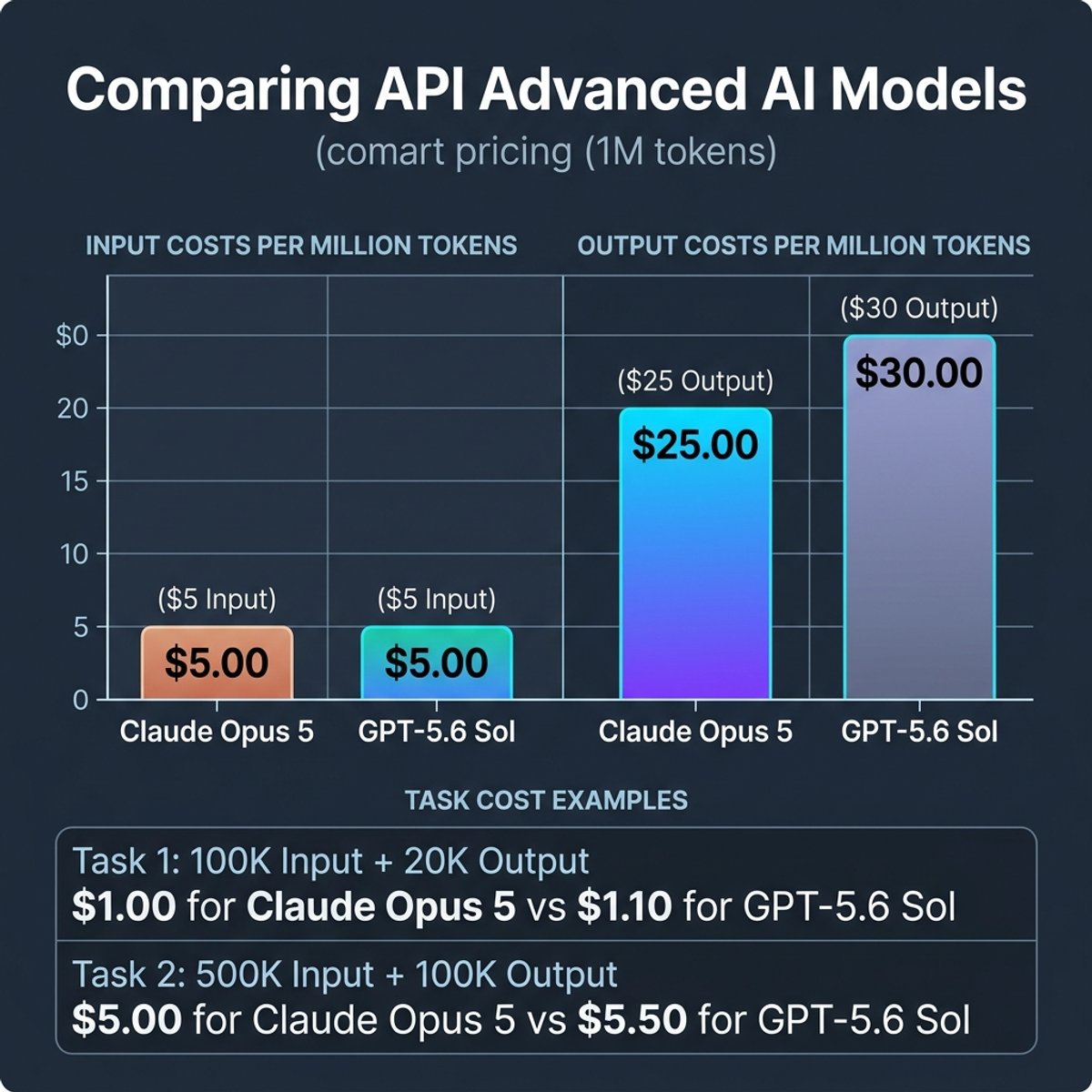
The two flagship models have the same input price, but Claude's output is cheaper:
- Claude Opus 5: $5 input / $25 output per million tokens
- GPT-5.6 Sol: $5 input / $30 output per million tokens
The basic formula is:
Total cost = (input tokens ÷ 1,000,000 × input price)
           + (output tokens ÷ 1,000,000 × output price)
For a task using 100,000 input tokens and 20,000 output tokens:
| Model | Estimated token cost |
|---|---|
| Claude Opus 5 | $1.00 |
| GPT-5.6 Sol | $1.10 |
↔️ Scroll horizontally to see all columns
For a larger agent task using 500,000 input tokens and 100,000 output tokens:
| Model | Estimated token cost |
|---|---|
| Claude Opus 5 | $5.00 |
| GPT-5.6 Sol | $5.50 |
↔️ Scroll horizontally to see all columns
These examples exclude tool charges, cache writes, repeated attempts, priority processing and other modifiers. OpenAI also applies higher rates to very large prompts above the threshold documented on its model pages. Anthropic offers prompt caching, batch discounts and a Fast mode that runs around 2.5 times faster at twice the standard token price.
For high-volume applications, the flagship comparison may be the wrong one. GPT-5.6 Terra costs $2.50 per million input tokens and $15 per million output tokens, while Luna costs $1 and $6 respectively. A cheaper model that completes the task reliably can deliver better value than a premium model used by default.
Availability and ease of use
Claude Opus 5 is available through the Claude API and supported cloud platforms. Anthropic says it is the default model for Claude Max and the strongest model available on Claude Pro. Claude Code is included with eligible Pro, Max, Team and Enterprise subscriptions, although API usage is billed separately from consumer subscriptions.
GPT-5.6 Sol is gradually rolling out to eligible ChatGPT accounts. OpenAI's current plan table lists Medium and High reasoning for Plus, while Pro, Business and Enterprise receive broader Sol access. Free and Go users do not receive Sol in standard ChatGPT conversations. Sol, Terra and Luna are available through the OpenAI API, and plan-dependent access is also available in Codex and ChatGPT Work.
Availability can change quickly, so check the model picker and official plan documentation before subscribing for one specific model.
Safety, privacy and limitations
Both models can make confident mistakes. That remains true even when an output includes citations, passing tests or a polished presentation.
Agentic access raises the stakes because the model may be allowed to change files, run commands or interact with external services. Use a sandbox for untrusted code, restrict credentials, require confirmation for irreversible actions and keep backups.
The models also enforce different safeguards. Anthropic says Opus 5 blocks or restricts some higher-risk cybersecurity actions and can fall back to another Claude model. OpenAI says GPT-5.6 includes stronger checks for sensitive biological and cybersecurity requests. Legitimate security researchers may encounter restrictions on either platform.
Do not upload confidential material until you have reviewed the relevant consumer or enterprise data terms for the exact product being used.
Which model should you choose?
| User or workload | Better starting point | Why |
|---|---|---|
| Solo developer handling difficult refactors | Claude Opus 5 | Strong evidence for careful, long-running repository work |
| Team already using Codex and OpenAI tools | GPT-5.6 Sol | Better ecosystem fit and broad tool integration |
| Document-heavy professional research | Claude Opus 5 | Leading agentic knowledge-work results |
| Web-heavy research and browsing | GPT-5.6 Sol | Strong BrowseComp results and integrated browsing tools |
| Single long-running agent | Claude Opus 5 | Emphasis on persistence, checking and iteration |
| Multi-agent application | GPT-5.6 Sol | OpenAI's Responses API includes multi-agent beta |
| Cost-sensitive production workload | GPT-5.6 Terra or Luna | Much lower token prices than either flagship |
| Very high-volume routine work | A smaller model first | Premium reasoning may add unnecessary cost and latency |
↔️ Scroll horizontally to see all columns
Final verdict: Is Claude Opus 5 better than GPT-5.6?
Claude Opus 5 is better than GPT-5.6 Sol for some of the hardest coding and agentic knowledge-work tasks, but it is not the universal winner.
The freshest standardized evidence gives Claude a narrow overall intelligence lead, a clear advantage on GDPval-AA v2 and a joint lead in coding-agent performance. It also charges less for output tokens. That makes Opus 5 an excellent default for demanding code review, large-document analysis and long-running single-agent work.
GPT-5.6 Sol remains the stronger choice for users deeply invested in ChatGPT, Codex and the OpenAI API. Its browsing, computer-use and multi-agent capabilities can outweigh a small benchmark gap, while Terra and Luna make the wider GPT-5.6 family more flexible for production costs.
A practical decision rule is simple: choose Claude Opus 5 when judgment and sustained execution are the bottleneck; choose GPT-5.6 when orchestration, connected tools or model-tier flexibility matter more.
Frequently asked questions
Is Claude Opus 5 better than GPT-5.6 Sol?
Not in every category. Claude Opus 5 currently leads several overall and professional-work evaluations, while GPT-5.6 Sol remains highly competitive in terminal coding, browsing, computer use and multi-agent workflows. Your tools and task type matter more than a small overall score difference.
Which model is better for coding?
Claude Opus 5 is a strong first choice for code review, difficult debugging and large repository changes. GPT-5.6 Sol may be preferable inside Codex or when a workflow depends on OpenAI's hosted tools and multi-agent support. Both require tests and human review.
Which is better for research?
Claude Opus 5 appears stronger for document analysis and professional deliverables. GPT-5.6 Sol has a strong case for web browsing and research connected to OpenAI's tools. Neither model guarantees accurate citations.
Is Claude Opus 5 cheaper than GPT-5.6 Sol?
Their standard input price is the same at $5 per million tokens. Claude's output price is $25 per million tokens, compared with $30 for GPT-5.6 Sol. Total cost still depends on token usage, caching, tools and retries.
Can free users access these models?
OpenAI says GPT-5.6 Sol is not included for Free or Go users in standard ChatGPT conversations. Claude offers a free plan, but Opus availability and usage are concentrated in paid plans. Check the current model picker because rollouts and plan access can change.
What is Claude Opus 5's context window?
Claude Opus 5 supports a one-million-token context window and up to 128,000 output tokens in the synchronous Messages API. A large context window does not guarantee perfect recall across every included document.
Should you trust AI benchmark scores?
Use them as evidence, not a final purchasing decision. Results depend on prompts, reasoning effort, tools, agent harnesses, token budgets and scoring methods. Test your own representative tasks before deploying either model at scale.
Sources and methodology notes
- Introducing Claude Opus 5 — Anthropic, July 24, 2026 — Launch positioning, reported benchmark performance, safeguards and availability.
- Models overview — Anthropic — Model ID, context window, output limit, knowledge cutoff and adaptive thinking.
- Claude API pricing — Anthropic — Standard, cached, batch and Fast mode pricing.
- GPT-5.6 launch — OpenAI, July 9, 2026 — Model-family positioning, benchmark results, knowledge work and multi-agent features.
- GPT-5.6 Sol model documentation — OpenAI — Context window, maximum output, cutoff and API pricing.
- GPT-5.6 in ChatGPT — OpenAI Help Center — Plan and product availability.
- Opus 5 evaluation — Artificial Analysis, July 24, 2026 — Intelligence Index, GDPval-AA, AA-Briefcase, coding-agent and factual-reliability results.
Editorial note: This article separates official company claims, third-party evaluation results and TechAffiliate testing. TechAffiliate did not perform a controlled hands-on comparison for this version. Specifications, prices and availability can change after publication.
Affiliate Disclosure
TechAffiliate may earn a commission if you purchase through our links. This helps support our work but does not influence our reviews. We always provide honest assessments of all products.
Related Articles
 AI & Machine Learning
Jun 18, 2026 • 18 min read
GLM-5.2 Review (2026): Benchmarks, Free Access & How to Use It
GLM-5.2 is the leading open-weights AI model from Z.ai. Explore benchmarks, pricing, MIT licensing, 1M-token context, and learn how to use GLM-5.2 for free.
 AI & Machine Learning
Jul 1, 2026 • 21 min read
LongCat-2.0 Explained: Meituan's 1.6T Open-Weight AI Model Targeting GPT-5.5 and Claude
LongCat-2.0 is Meituan's 1.6T open-weight MoE AI model with a 1M context window and agentic coding focus. What's confirmed, claimed, and unverified.
 AI & Machine Learning
Dec 25, 2025 • 17 min read
56% Salary Jump: 7 AI Skills That Got Indians ₹7L Raises
Indian professionals with AI skills earn 56% more (₹12L to ₹19L+). Learn the 7 most in-demand AI skills in 2026, with step-by-step learning paths, free resources, and real salary data from ₹6.6L to ₹2.6Cr.
Comments (0)
Leave a Comment
No comments yet
Be the first to share your thoughts!