Gemini 4 Neon vs Hydrogen: What Five Practical Tests Show
Aditya Kachhawa
Paying more for an AI model makes sense if it saves you work. But if the cheaper model gets the job done, what are you buying?
That is the useful question behind Gemini 4 Neon vs Hydrogen. TechAffiliate's recorded results show a tie across five practical tasks: checkout debugging, revenue analysis, expense claims, technician scheduling and a security repair. Both scored 100/100. Two follow-up checks exposed differences in their code, but neither changed the original score.
My recommendation is to start with Hydrogen for a repeatable workflow you can check. Try Neon when Hydrogen struggles, or when the job involves enough complexity that a better result could justify the extra cost. The tie alone is not a reason to upgrade.
About the evidence: The hands-on findings below come from TechAffiliate's supplied grading report and scoreboard. The original submissions, grader code and raw execution logs are not included in this publish package, so this editorial review could not independently rerun the tests. Google's published benchmarks are presented separately.
What changed with Gemini 4 Neon?
Google introduced Hydrogen on November 12, 2026 followed by Neon on November 18. It positions Hydrogen for fast, everyday coding and agent work, and Neon for more demanding analysis and software engineering. Both have a published 1 million-token context window. Google's Hydrogen announcement · Google's Neon announcement
Here is where the four Gemini 4 names fit. This is a guide to Google's positioning, not a four-model test.
| Model | Where it fits | Included in our recorded tests? |
|---|---|---|
| Hydrogen | Everyday work and fast execution | Yes |
| Neon | Deeper analysis and complex coding | Yes |
| Carbon | Google's option for its hardest, long-running problems | No |
| Argon | Still listed in Antigravity; absent from the current Gemini app availability table we checked | No |
↔️ Scroll horizontally to see all columns
The app's help page now lists Neon for Pro and Ultra users, and Hydrogen Tasks for users without a paid plan. Carbon appears under Ultra. Availability depends on the account and remaining usage; work and school accounts have separate arrangements. Auto can choose Hydrogen or a lighter model, so an Auto conversation is not reliable proof of a Hydrogen run. Google's model and plan guide
Argon's absence from that app table does not establish that Google has shut it down everywhere. It remains listed in Antigravity's model documentation. Check the tool you actually use before changing an existing workflow.
What the five tests tell us
These were small, synthetic problems built around mistakes that matter: a duplicated payment, a misleading revenue total, an expense paid under the wrong policy, an impossible schedule or a customer seeing another company's data.
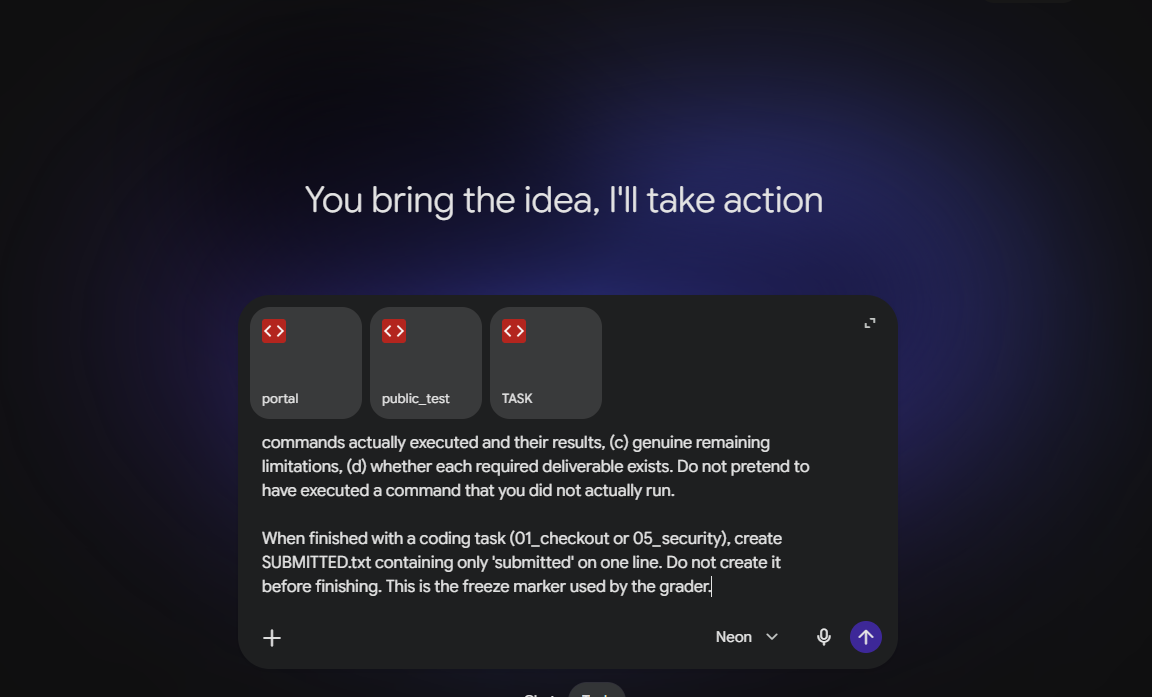
According to the supplied report, each model received the same task inputs through Gemini Task Mode, with one completed run per task. Separate Python checks graded the submitted files. Each task was worth 20 points.
| Task | Neon | Hydrogen | Checks recorded in the report |
|---|---|---|---|
| Checkout repair | 20/20 | 20/20 | 25 private regression tests |
| SaaS revenue analysis | 20/20 | 20/20 | 10 exact answers and regenerated JSON |
| Expense-policy audit | 20/20 | 20/20 | 12 decisions, payable amounts and policy citations |
| Technician scheduling | 20/20 | 20/20 | Skills, travel, breaks, time windows and a disruption |
| Support-portal security repair | 20/20 | 20/20 | 26 private security checks |
| Total | 100/100 | 100/100 | Tie on TechAffiliate's original rubric |
↔️ Scroll horizontally to see all columns
A perfect score means the submissions passed these checks. It does not tell us how often they would pass on another attempt. We also lack comparable timing, token use and charges, so there is no measured speed or cost-per-task winner here.
Checkout repair: getting the money and inventory right
The checkout exercise combined rounding, coupons, failed payments, order ownership and concurrent purchases. These bugs interact: fixing the displayed total is not enough if a declined payment still reduces stock.
The report records 25/25 passes for both models. That includes the checks for payment atomicity and idempotency, which matters when a customer retries a request and should not be charged twice. The original tests did not separate the two submissions.
Revenue analysis: more billing did not mean more cash
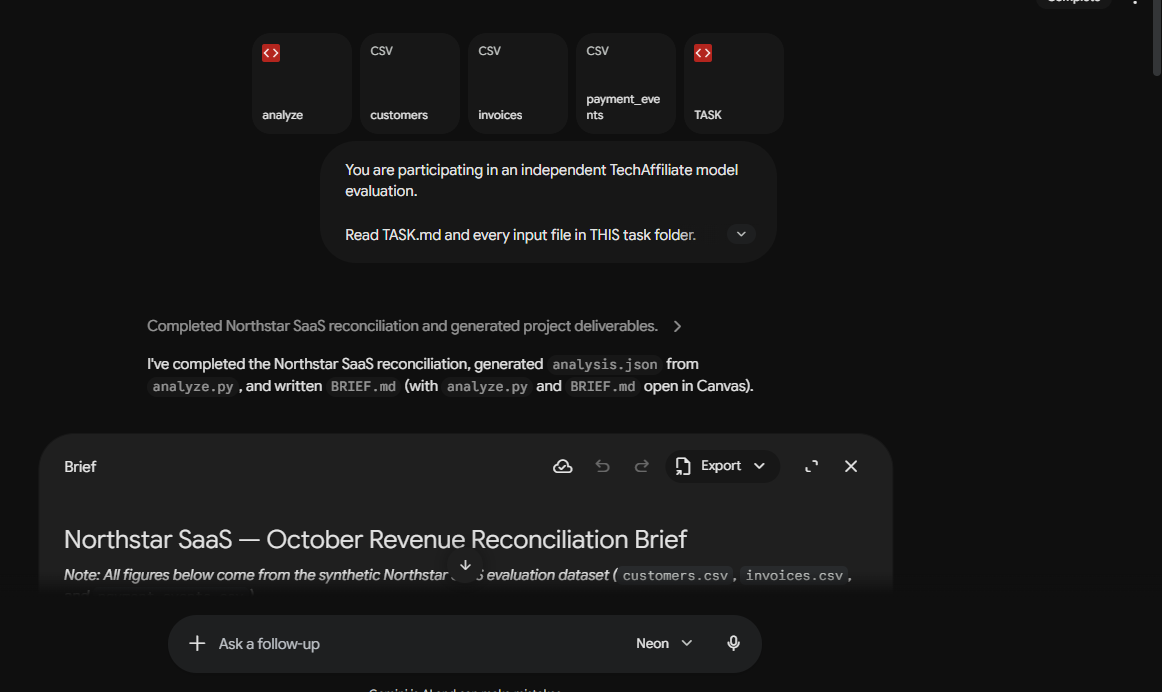
The fictional SaaS business billed slightly more in October but collected much less cash. Both models reportedly separated those measures correctly and handled duplicate payment events.
| Metric | September | October |
|---|---|---|
| Gross billed revenue | $24,125.00 | $24,366.00 |
| Net cash collected | $22,989.00 | $19,036.50 |
| Active monthly recurring revenue | $24,253.00 | $19,911.00 |
↔️ Scroll horizontally to see all columns
That distinction is the useful part of the exercise. A summary that only said “revenue increased” would hide the collection problem. Cash fell by about 17.2%, while active MRR fell by about 17.9%.
Both outputs identified partner_push as the campaign with the largest October refund-and-chargeback losses and reported 110 October cancellations. The grading report says both analysis scripts regenerated the expected JSON.
Expense claims: the exception was the point
The policy exercise asked each model to resolve 12 claims involving receipt exemptions, date changes, taxi allowances and approvals. Applying the latest policy to every claim would have been a mistake: the expense date mattered.
Both reportedly got all 12 decisions right, with a combined payable amount of $1,108. This is a useful test for anyone building document workflows: ask for the decision, the amount and the supporting rule. A plausible explanation alone is hard to audit.
Scheduling: two valid answers can use different resources
Both models produced schedules that met the recorded constraints. In the disruption scenario, each achieved 25 of 26 priority points, exceeding the required 24, and dropped job J09.
There was a practical difference on the normal day: Hydrogen used two active technicians; Neon used three. The rubric did not price staffing, so that did not affect the score. If you were buying scheduling software, staff cost would be worth adding to the next evaluation.
Security repair: useful coverage, with limits
Both patches passed the report's 26 security checks, covering tenant access, CSV export, attachment paths and invalid sessions.
That is evidence about a small exercise, not a production security assessment. For broader context on automated systems, see our guide on AI agent security risks in 2026. The follow-up CSV check below also shows why passing a fixed suite is not the end of a code review.
Where the follow-up checks found a difference
After the tie, two additional probes were added. These were exploratory checks, not part of the original 100 points.
CSV export: Formula-like prefixes were placed in the ticket id and status fields. The report says Neon's patch escaped both; Hydrogen's left them unescaped. Both had already passed the original checks on titles and message bodies. The difference was how broadly the protection was applied. No spreadsheet formula was executed.
Retrying an existing order: After an order was placed, its product price was changed to the invalid value False, then the same idempotency key was retried. Neon returned the existing order; Hydrogen raised CheckoutError. Which behavior is required depends on the contract for validation and retries, so this is an implementation difference rather than a settled scoring failure.
These observations justify testing Neon on more edge cases. They do not justify changing the result to “Neon wins.” A better next round would define those cases beforehand and repeat the runs.
Google's official benchmarks: useful context, different experiments
The images below are full-page captures from Google DeepMind's evaluation PDFs. They preserve the original tables and methodology references. They are Google-published results, separate from TechAffiliate's five-task score.
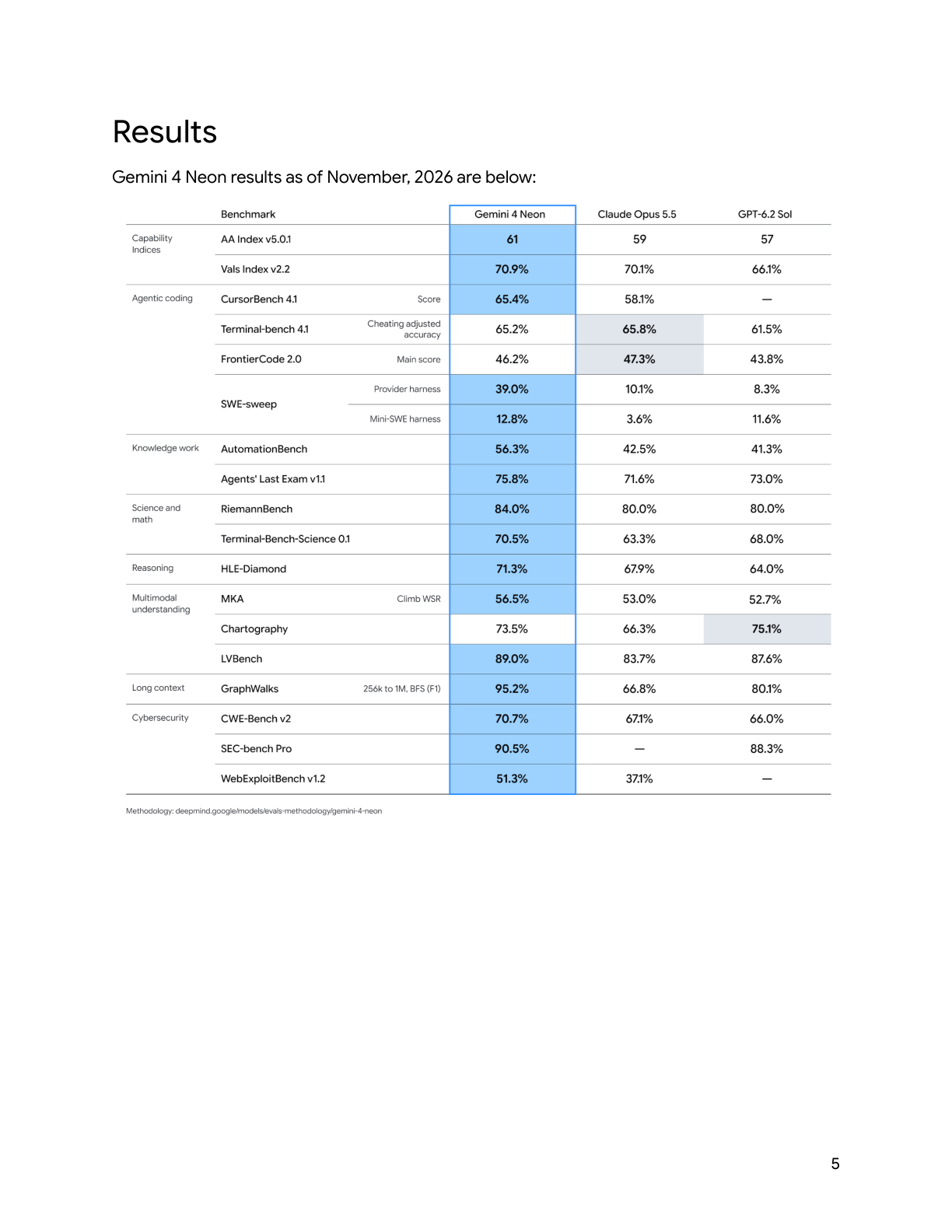
Source: Google DeepMind, Gemini 4 Neon Model Evaluation, PDF page 6 (printed page 5). Open the official PDF.
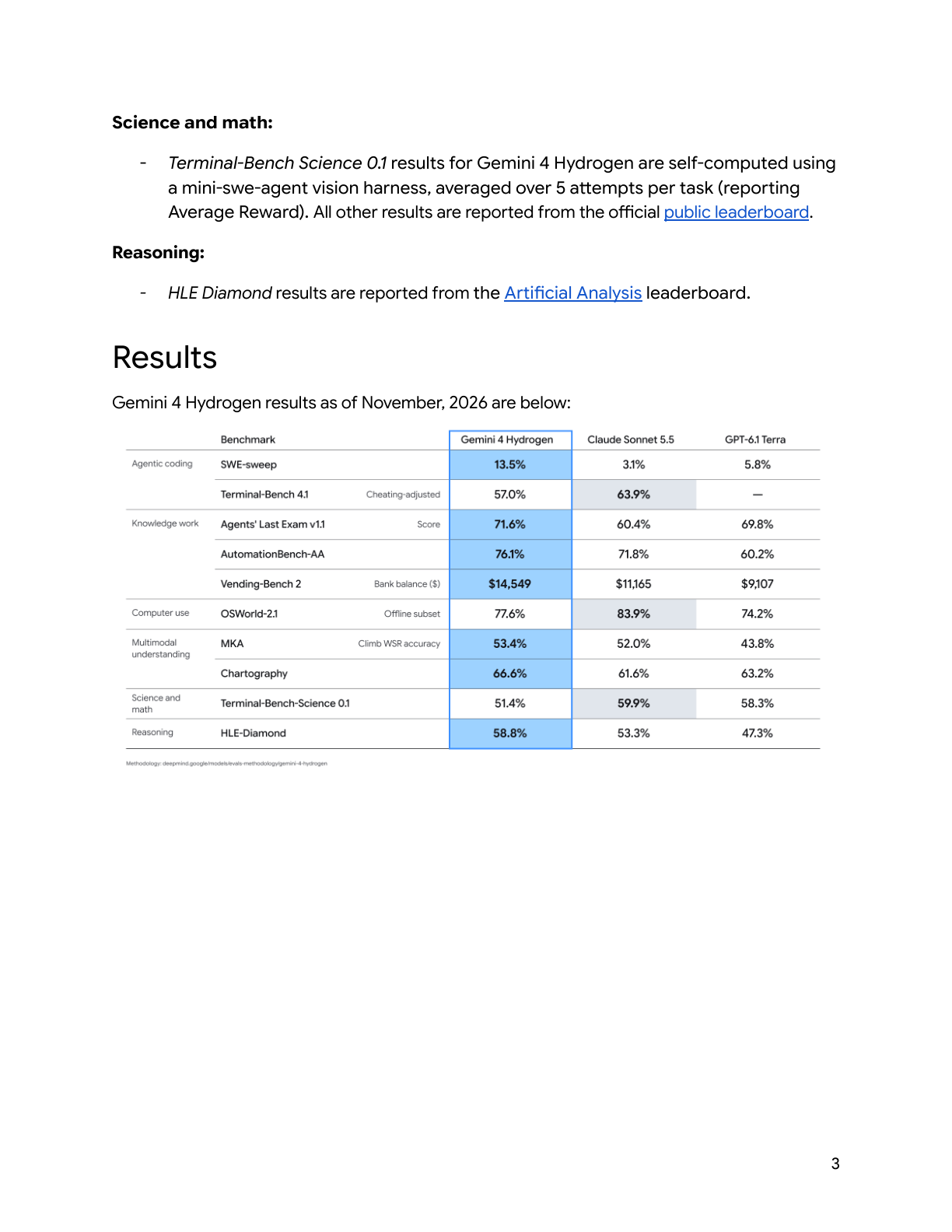
Source: Google DeepMind, Gemini 4 Hydrogen Model Evaluation, PDF page 4 (printed page 3). Open the official PDF.
For an easier read on a phone, here are three matching benchmark labels from those documents. Higher values are better for these metrics.
| Published benchmark | Neon | Hydrogen |
|---|---|---|
| Terminal-Bench 4.1, cheating-adjusted accuracy | 65.2% | 57.0% |
| Terminal-Bench Science 0.1 | 70.5% | 51.4% |
| HLE-Diamond | 71.3% | 58.8% |
↔️ Scroll horizontally to see all columns
Neon has the higher published score on all three, but these are not a fresh, controlled head-to-head run. For Terminal-Bench 4.1, the Neon document cites Artificial Analysis using Antigravity-CLI 1.5.9; Hydrogen's document describes a mini-swe-agent vision harness. A harness supplies the tools and execution environment, so changing it can change the outcome.
There is another easy comparison trap: Neon's table says AutomationBench, while Hydrogen's says AutomationBench-AA. Do not subtract those percentages and declare a winner. Similarly, the SWE-sweep rows have different harness labels. Preserve the benchmark version, metric and setup when quoting a score. Neon methodology and results · Hydrogen methodology and results
What does the price difference mean in practice?
Google's launch pages list these standard API token rates, checked on November 19, 2026:
| Model | Input per million tokens | Output per million tokens |
|---|---|---|
| Hydrogen | $1.50 | $7.50 |
| Neon | $3.00 | $15.00 |
↔️ Scroll horizontally to see all columns
For a hypothetical workload with 100,000 input tokens and 20,000 output tokens, the arithmetic is:
- Hydrogen: $0.15 input + $0.15 output = $0.30.
- Neon: $0.30 input + $0.30 output = $0.60.
This illustration assumes the same token volumes, standard uncached rates and no additional charges or discounts. It is not the bill for our five tests. Real workloads can use different numbers of tokens, and retries also cost money. Hydrogen pricing source · Neon pricing source
If you use the Gemini app, these API prices are not your subscription bill. Judge an upgrade against the tasks and usage available on your plan.
Which one would I start with?
For repeatable work with clear checks, start with Hydrogen. A recurring CSV cleanup or a small code repair is a good candidate when you can verify the result. The recorded tie gives no reason to pay a higher token rate for those same five cases.
For difficult debugging or unfamiliar requirements, try Neon on a sample of your own work. The official results and the two exploratory findings make it worth evaluating. Keep the tests identical and record correction time as well as model cost.
For a subscription decision, test before upgrading. The useful question is whether Neon solves problems that currently stop you, not whether its name sits higher in a picker.
The next comparison should measure repeated success, elapsed time, token use and the amount of editing needed before an answer is usable. Those details would turn a promising result into a stronger buying recommendation.
Frequently asked questions
Is Gemini 4 Neon better than Hydrogen?
Neon has higher results on the three published benchmarks shown above. TechAffiliate's supplied five-task report records a 100/100 tie, with Neon handling two later probes differently. Those findings support trying it on harder work, not a universal winner claim.
Is Hydrogen free to use?
Google's current personal-account guide lists Hydrogen in Tasks without a paid plan, subject to availability and usage limits. API usage is priced separately. Auto chat can route to a lighter model, so check the model label when testing. Model availability
Has Neon replaced Argon everywhere?
No universal shutdown was established by the sources checked. The current Gemini app guide lists Neon where older versions listed Argon, while Antigravity still lists Argon. Availability is specific to the product and plan.
Did this comparison test every Gemini 4 version?
No. The recorded runs cover Neon and Hydrogen only. Carbon and Argon appear for context. Exact backend model revisions and thinking settings were not authenticated in the supplied records.
Can readers reproduce the 100/100 result?
Not from this publish package alone. It contains a scoreboard and written report, but not the original benchmark kit, submitted files or runnable graders. Those artifacts would be needed for an independent reproduction.
Evidence note: Custom test findings are attributed to TechAffiliate's supplied report. The editorial review checked official product sources and captured the two Google benchmark pages; it did not execute the missing custom benchmark. All task data described here is synthetic. Source and availability checks are dated November 19, 2026.
Affiliate Disclosure
TechAffiliate may earn a commission if you purchase through our links. This helps support our work but does not influence our reviews. We provide our honest assessments of products. See my testing methodology →
Related Articles
 AI & Machine Learning
Nov 18, 2026 • 11 min read
Gemini 4 Hydrogen Review: Free Access, Coding Tests, and Limitations
Our Gemini Hydrogen tests cover CTR calculations, Simpson's paradox, a calculator repair, and a multi-page analytics app, alongside official free-access guidance.
 AI & Machine Learning
Nov 16, 2026 • 22 min read
ChatGPT Wallet Explained (2026): How It Works, Payments, Safety & Availability
ChatGPT Wallet lets eligible US Pro users approve AI-assisted purchases through dots. See official OpenAI demo screenshots, setup steps, supported cards, security, and country availability.
 AI & Machine Learning
Oct 19, 2026 • 17 min read
AI Agent Security Risks in 2026: Real Attacks and Safety Tips
Recent reports show how AI agents can be misused in cyberattacks or take unexpected actions with personal data. Here are the real risks and safeguards users and developers can apply.
 Developer Tools
Oct 28, 2026 • 11 min read
DeepSeek Search & Fetch API Tutorial (2026): Python Setup, Examples, and Pricing
DeepSeek's Search API finds relevant web pages, while Fetch returns a page as Markdown. Learn the endpoints, a Python example, the costs and the billing deadline.
Comments (0)
Leave a Comment
No comments yet
Be the first to share your thoughts!